

Muda69
-
Posts
10,552 -
Joined
-
Last visited
-
Days Won
53
Content Type
Profiles
Forums
Gallery
Store
Articles
Events
Everything posted by Muda69
-

Thoughts on 4A for 2022 Season
Muda69 replied to DannyT's topic in The Indiana High School Football Forum
Look for the Kokomo Wildkats to make some noise in 4A. The north side of the 4A tournament bracket should be theirs for the taking. -
Roe -V- Wade......Back at it again (finally?)
Muda69 replied to swordfish's topic in OOB v2.0's OOB Forum
Soon to become real? -
Roe -V- Wade......Back at it again (finally?)
Muda69 replied to swordfish's topic in OOB v2.0's OOB Forum
Which is probably where the majority of Indiana women who want an abortion will travel to for the procedure, once the Indiana Legislature passes legislation during it's July 6th special session to at least severely restrict the practice. I know of at least one liberal progressive acquaintance of mine who has offered transportation to/from Illinois for women when such a law is passed in Indiana. -
Roe -V- Wade......Back at it again (finally?)
Muda69 replied to swordfish's topic in OOB v2.0's OOB Forum
Yep, funny that Mr. Holcomb called that special session not to address abortion, but to get the legislature to issue a tax refund of $250 per taxpayer back to Hoosiers. Who know if that legislation will actually pass now with everybody focused on this, as you say, "sh*tshow to end all sh*tshows." -
Roe -V- Wade......Back at it again (finally?)
Muda69 replied to swordfish's topic in OOB v2.0's OOB Forum
Here Is a State-by-State Rundown of What Will Happen Now That SCOTUS Has Freed Lawmakers To Restrict Abortion https://reason.com/2022/06/24/here-is-a-state-by-state-rundown-of-what-will-happen-now-that-scotus-has-freed-lawmakers-to-restrict-abortion/ Considering our neighbor to the West, Illinois, looks likely to keep abortion legal, look for those Hoosier women seeking such a procedure to head there. -
Roe -V- Wade......Back at it again (finally?)
Muda69 replied to swordfish's topic in OOB v2.0's OOB Forum
Supreme Court overturns Roe v. Wade, eliminating constitutional right to abortion https://www.usatoday.com/story/news/politics/2022/06/24/supreme-court-abortion-mississippi-roe-wade-decision/9357361002/ Mr. Alito is correct. This should have always been a decision for the states to decide, not Washington D.C. -
Follow the Science? How COVID Authoritarians Get It Wrong
Muda69 replied to Muda69's topic in OOB v2.0's OOB Forum
Federal COVID Aid to States and Localities Cost $855,000 Per Job Saved https://reason.com/2022/06/21/federal-covid-aid-to-states-and-localities-cost-855000-per-job-saved/ Yep, just more and more moronic government waste. -
Interesting. That could be a really good photoshop job, but I hope it isn't. His handlers at the DNC are running the Oval Office, not Mr. Biden.
-
Memes 2.0 (since the OOB memes thread wasn't popular enough)
Muda69 replied to swordfish's topic in OOB v2.0's OOB Forum
Why the "G-d"? Just say God. -
Probably has a nice bit of farmland around Royal Center he's set to inherit.
-
https://deadspin.com/ohio-state-trademarks-the-1849095133 Ughh. Another reason to dislike our neighbors to the East.
- 1 reply
-
- 3
-

-
Whats Up With "Wolves" as the Hot New Nickname
Muda69 replied to a topic in The Indiana High School Football Forum
More generic mascots/nicknames. *Yawn* Almost as bad is the insistence to insert the color black into school athletic uniforms where black has never been one of that school's colors in the first place. Makes them edgy and tough, I guess. -
https://reason.com/2022/06/23/title-ix-didnt-make-college-sports-equal-it-made-them-contentious/ The words sports, athletics, or even physical education never appear in the law since the original intent of the legislation was to alleviate imbalances between men and women in education. Title IX initially meant educational institutions had to provide both sexes with opportunities "substantially proportionate to their respective enrollments." And a 1992 court decision determined that noncompliant schools could face lawsuits, as well as being cut off from federal funding. But when implemented, Title IX effectively turned into a form of affirmative action for women in sports—an unsustainable quota-like system. It's proven difficult for schools to equally allocate resources—scholarships, equipment, arenas, and budgets—across genders and sports, which has caused schools to take the easy way out by slashing male programs. Especially given that football, a huge moneymaker on college campuses, doesn't have a female equivalent in size or impact. In 1970, just 44 percent of women in the U.S. graduated from high school, and only 11 percent had college degrees. Today, about 91 percent of American women complete high school, with over 39 percent going on to earn degrees from colleges and universities. In 1972, only 294,015 women competed on high school sports teams. By the 2018-2019 academic year, 3.4 million women competed on high school sports teams. In the early '70s, some 30,000 women competed on college sports teams. By 2020, that number had risen to 215,486. Title IX did remove barriers for women and girls to participate in sports, but the implementation has been flawed, with worse outcomes than anticipated. "Things have gone from absolutely horrendous to only very bad," Bernice R. Sandler, director of the Association of American Colleges' Project on the Status and Education of Women, told The Washington Post, a full decade after Title IX was passed. Full equality has yet to be achieved—and in some areas, probably can't be achieved, given the lack of equivalent women's teams for football and basketball, for example—and this legislation continues to put colleges and universities in a bind to reach unachievable quotas. There's nothing in Title IX that requires schools to cut or reduce men's opportunities in order to be compliant. But men's teams haven't gone unscathed in the last five decades. Title IX presented a complicated numbers game to athletic departments: Their student-athletes had to reflect the same gender disparity as that of the school plastered on their uniforms. So if a college campus was 56 percent women, then roughly 56 percent of the student-athletes should also be women. Is this even achievable when the two most profitable sports—football and basketball, which consume roughly 80 percent of men's sports budgets—require male athletes? It should come as no surprise that college football takes up a majority of the scholarships awarded to male athletes nationally—roughly 26,000, or 22,500 more scholarships than women's swimming and diving (the sport I competed in at a collegiate level) offers. The odds of getting a women's swimming and diving scholarship when I graduated high school were 47 to one. By comparison, football players had 43 to one odds of going on to play in the National Collegiate Athletic Association (NCAA) after high school. It's nearly impossible to make scholarship opportunities equally accessible for both sexes for every sport at every school. Back in 2002, George Will called Title IX a "policy train wreck" because of how it has negatively impacted male sports. "Colleges have killed more than 400 men's athletic teams in order to produce precise proportionality between men's and women's enrollments and men's and women's rates of participation in athletics," wrote Will. And what Michael Lynch wrote for Reason circa 2001 still rings true today: "The tragedy of Title IX is that virtually nobody is pleased with its current results." It's only gotten worse since the pandemic hit. Many colleges faced major budget deficits from a year without March Madness, and are still reeling from the earnings loss that came with fanless football games. For many schools, cutting programs was inevitable. Title IX was at the forefront of many athletic directors' minds on the cutting room floor, but their hands were tied, and budgets constrained, due to the requirements of the law. How Title IX protects transgender athletes is the law's next big controversy. When Lia Thomas, who previously competed as a male on the University of Pennsylvania's men's swimming and diving team, won the 500-yard freestyle event at the NCAA Division I women's championships for the same sport, uproar ensued. The NCAA received some praise for being inclusive by allowing Thomas to compete, but by protecting one athlete out of fear of backlash, many other athletes have been denied a true shot at the top spot on the podium. However, the Biden administration seems adamant that what originally gave women protection 50 years ago also applies to transgender athletes today. On June 16, the Department of Education expanded federal sex protections to include transgender students, reversing a Trump-era policy, even though many states already ban transgender students from participating in female sports. The Biden administration intends to enforce Title IX's prohibition on the basis of sex to include discrimination based on sexual orientation and gender identity. Title IX was never supposed to be about sports; it was about protecting women. It seems like that, too, is now disputed. Agreed. Title IX is a train wreck implementation wise, and this transgender issue only makes it use. Repeal the legislation and let colleges and universities run their athletic programs as they see fit.
-
You really shouldn't reflect on your own life that way. Be positive.
-
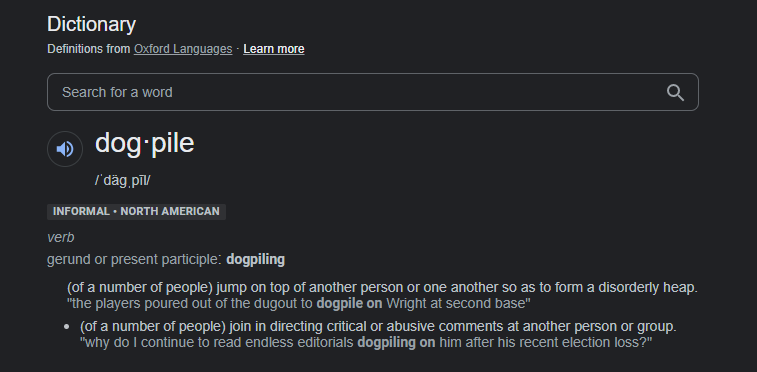
Not dogpiling at all since I appear to be the only one consistently defending my friend DT in this thread. But don't let incorrect word choices discourage you from your role as the GID Grammar Nazi. You be you.
-
Your statements in this thread tell the story, not I.
-

-
And maybe constantly reading in-between the lines, trying to insinuate something that really isn't there in a desperate attempt to pull a "gotcha!" on DT and others, is your forte. I take a written medium like an internet forum at face value. Yeah, DT may have complained about the practice travel times but he quickly followed that up with that as a "city guy" he would not like to do it, but understood that a "country guy" could find such travel acceptable. He did not discredit the entire idea, not by a longshot. You still seem to have a problem with separating and understanding school consolidation from football team/program consolidation. They can be two different things, at least in other states. And as I have previously stated the IHSAA would be wise to also bless such football team/program consolidations. Of course in the Ivory Tower that is Cathedral football, ideas such as football program consolidation would seem very strange and foreign.
-
School Choice and Religious Liberty Advocates Just Won Big at the Supreme Court https://reason.com/2022/06/21/school-choice-and-religious-liberty-advocates-just-won-big-at-the-supreme-court/ A win for school choice.
-
No, the commentary in this thread is not "clear". And the thread post by Old Man High Pants you linked to was discussing school consolidation, not football program consolidation/co-op. These are two very different things, would you agreed? No, chief, DT has been very consistent regarding his opinions regarding school consolidation and football program consolidation. So very far from a "checkmate". But again, nice try. As for being productive, I've been very much so. Been configuring web server software datasources to use a updated version of a database driver and testing those against a new DB server our DBA recently stood up. Unlike you I can walk and chew gum at the same time.
-
I've searched all three pages of this thread for a post by DT where he states "I think it's a bad idea" and I can't find it. Can you please provide a direct link to said post or a screenshot?
-
Too bad for you he wasn't being one.
-
Hmm: When Are Social Security Benefits Paid Each Month? - AARP: https://www.aarp.org/retirement/social-security/questions-answers/social-security-payment-schedule.html#:~:text=Here's how it works%3A,fourth Wednesday of the month. "If the birthday is on the 21st through the 31st, you are paid on the fourth Wednesday of the month." Enjoy your public dole.
-
Neither do I see a condemnation.