

foxbat
-
Posts
9,580 -
Joined
-
Last visited
-
Days Won
357
Content Type
Profiles
Forums
Gallery
Store
Articles
Events
Everything posted by foxbat
-

The p/p hegemony continues unabated
foxbat replied to Muda69's topic in The Indiana High School Football Forum
A couple of things to be careful of with Chatard is that the reason that they aren't still in 4A has little to do with the IDEA of SF not working and much more to do with anomalies. As such, I'm not all that worried about Chatard in the long run having an impact on the landscape. Realize that Chatard has been in 4A twice under SF: In 2013, they ran into New Pal in its ascendancy toward a 2014 state title. Likely half a dozen other sectionals and they would have gotten more points. In 2014, they dropped a post-season game to Roncalli. The problem with the 2013-2014 SF cycle is that it required 4 POINTS to stay up. Cathedral is the only team that I recall that was part of the inaugural SF crowd that actually remained on POINTS ... a couple of others went for SF and stayed for enrollment. Even without running into New Pal in 2013, I think the chances of most teams garnering 4 points would be hard to see happening. Even LCC, who headed to semi-state and dropped a 3-point game with the eventual 2A winner in 2014, RCHS, only picked up a total of 2 points on the cycle. I would not count the 2013-2014 SF cycle as an indicator for any data points because the 4-point stay requirement was high-flawed and basically made the first SF cycle more like a beta test, at best, than anything else. In 2021, they went up again, but only stayed for a single season due to the "COVID factor" and the IHSAA sticking them in a sectional with Roncalli. That year, LCC had 1 point in 2A and stayed up and Chatard had 0 points in 4A and dropped back down. The two-year cycle problem was even worse as a one-year cycle. In essence, I wouldn't necessarily say that Chatard not staying up in 4A is something that will require them figuring out "how to get better" or weather 4A. The two times that they ended up in 4A were both not what I would consider regular cycles for figuring potential/trends given the stay-point flaw and the COVID anomaly treatment. Incidentally, I think the IHSAA is making a mistake moving from a 2-point stay requirement to a 3-point stay requirement. Pretty much that means if you don't make it out of sectionals in any year of the cycle, you need a ring the next year to stay ... and that's getting into anomaly territory again. -
The p/p hegemony continues unabated
foxbat replied to Muda69's topic in The Indiana High School Football Forum
-
The p/p hegemony continues unabated
foxbat replied to Muda69's topic in The Indiana High School Football Forum
Appreciate it! -
The p/p hegemony continues unabated
foxbat replied to Muda69's topic in The Indiana High School Football Forum
So I'm not sure I qualify as the guy you are looking to answer. My parents both had Catholic education all of their life with my mom finishing from a Catholic college and my dad leaving Catholic college for the military and then finishing from a public university. I went to Catholic school through 6th grade and then did public school for everything else through college. Two of my kids have attended Catholic school, but all have also been homeschooled and attended public schools ... my three girls from Jeff and my oldest son finishing at Harrison this year and the youngest probably attending Harrison part-time for high school. Nonetheless, I've been thinking about this issue for a bit and frankly, haven't yet been able to come up with a set of items that works for the argument as to why p/ps, in general win, that can then be applied across the board. What I have been leaning toward though is something akin to the idea that it's less categories and more programs. When I look at the issue in short timeframes, like this thread does every season, it's fairly easy to generalize. Even when several short-terms are pieced together, that generalization is easy, but some things don't seem to specifically match up with the general premise. With that said, I'm coming at this very much so from an Indiana perspective with some additional insights from Texas and Louisiana; but mainly Indiana. The premise has often been, if there isn't some advantage, then how does x percentage win y percent of the time? @Bobref has pretty much trademarked on GID that correlation doesn't necessarily indicate causation. That got me to thinking through some things that, rather than focusing on the generalities and trying to make an all-encompassing theory, I'd look at some case studies and try to work from there. Also, and I don't recall who it was that asked the question in another thread, but what got me thinking about this was a general question that was asked about 6A ... which was never really fully answered or even really solidified. The question was, and is very similar to the question first posited in the thread, "Why is it that only four teams/programs have ever won 6A?" It went on to, and rightly so, point out that there weren't similarities between the schools as there are differences in size, FRL items, communities, offenses/defenses, etc. It just kind of ended up as a mystery. Four teams out of roughly 40 teams that have been in and out of 6A since its inception 11 years ago, roughly 10%, have not only won SOME of the titles, but ALL of the titles in that class. What is the categorization that defines that four programs that you could "bottle" or is it something much more complex that can't fit on a bumper sticker? So let me start and see if the idea can perhaps be expanded by others with some real discussion on things. The program that I'm most familiar with is LCC. A couple of my kids attended Catholic school until the 3rd and 5th grade, but I coached in a youth program there for 18 seasons. LCC first started playing ball back in 1958. As seen in a couple of other threads currently in play, while LCC has a mystique about it that has it mentioned as a storied p/p powerhouse, it's really been about the last 15 years or so that LCC has probably earned that mystique. It entered into a storied four-peat era back in 2009-2012, but prior to that, it was pretty much feast or famine according to season outcomes on Harrell's. So I'll ask the first question that catches my eye with LCC and the statements often made about p/p in general. If p/p have the automatic advantage, why did LCC have such gaps between its pre-four-peat timeframe? Starting from 1976, until 2009 ... a 34-year period ... LCC got out of sectionals four times with gaps of 13, 10, and 6 years between each. Incidentally, in every season for LCC, until 2021, when their season ended without a state title, it came at the hands of public schools ... only the last three seasons, in 2A, has LCC's season been ended by another p/p. BTW, not just one p/p-killer public school, although Pioneer has a storied tradition for jousting with LCC, but over a dozen public schools have delivered deathblows to LCC's post season. So if the idea that there's an inherent p/p advantage that LCC has, then why was it not there in force in the 34-year period and, probably more importantly, what were the MANY public schools doing that was causing LCC seasons to end really early in that timeframe? Of course, Noll is always mentioned. Noll has a very storied past in that it never seemed to have any p/p mojo outside of 1989 when it won 3A. Outside of that, according to Harrell's, Noll made it to a sectional championship only three times, never making it out of the sectional, and has been ousted in the first game of sectionals for the last decade ... all by public teams. Ritter has an amazing past. Five state titles with three in 1A and two in 2A. For a long time, they were one of the poster children for p/p dominance, but now, closing in on a decade, no one whispers their name anymore. Their last state title was in 2016; however, since then, they haven't made it out of a sectional. They've also not even been close oustings. The closest they got was this year's 23-point second sectional game loss to Eastern Hancock. Maybe they have a string of "bad classes" ... the opposite of those "good classes" that public school lament might SF them unfairly into the next higher class ... but, for all of the talk about p/p mojo, four losing seasons in the last seven and three of the last four would seem to indicate that reloading, which is fairly automatic for p/p schools as I've been told, would seem worrisome and not in line with the meme. Heritage Christian ... an often forgotten p/p ... maybe because they aren't Catholic. Only has around a two-decade history history according to Harrell's. Has back-to-back state appearances in 2007-2008 with one blue ring. Outside of that, two sectional titles in 2019-2020. Has a mix of being ousted by both public and private schools. Fairly good records, but not really drawing any of the p/p ire directed at the categorization as a whole. Culver Academy has been around since the mid-1980s, yet only has a pair of sectional titles spaced a decade and a half apart ... 2000 and 2015. Again, almost never referred to or draws the ire of the p/p category and I've NEVER in over two decades of being in Indiana ever once heard anyone talk about the unfair advantage that Culver Academy has, not only as a p/p, but a p/p that has had students on its rosters from foreign countries! Wanna talk about recruiting or being outside of a youth program circle? Also, Culver Academy used to be Culver Military Academies, so I'm pretty sure that their lack of state titles wasn't due to not being competitive. Again, I don't have a specific answer to your question because the general answer that folks hope is given doesn't fit with all of the categorization. Just the subset above actually refutes the generalized statements that tend to be made. Also, I see the issue as being more complex than many of the bumper-sticker takes that have been bantered around. I think there's something to be said for focused, driven groups in a school, but similarly, I would contend that Noll, LCC, and others have been equally focused, driven, etc., if the narratives are to be fully-embraced, but the outcomes don't seem similar. With that said, what I think MAY be an issue is that there may be advantages that come from said make-ups, but that they aren't uniformly autonomous and that what's actually happening, which dovetails back into the 6A questions is that programs, and not necessarily categories, have figured out how to wield/harness the power as opposed to demographics. I also believe that, and Ritter and LCC look like interesting cases for this, that while a program may be able to leverage some type of advantage, it isn't necessarily something that's inherent and automatic by birthright of categorization and, for example in the case of Ritter, it may be something that isn't eternal. -
The p/p hegemony continues unabated
foxbat replied to Muda69's topic in The Indiana High School Football Forum
You'd probably win that bet with no problem. I'd bet, given the current state Indiana, you might might even end up with more transfers between public schools that between p/p and public either way. -
Given that they lost 80-2 to Indiana School for the Deaf this last season, I'd expect any exodus to be really slow. The only major short-term impact to the area, if that, is likely to be the couple kids a year from the LCC youth program that used to come from Faith, but then returned to Faith after sixth grade or went to public schools. Previous Faith youth players that played for LCC have ended up at Harrison/McCutcheon and West Lafayette ... although there's one who's back at Faith right now. Maybe a couple hands worth over the past 20 years. Girls' basketball and volleyball and boys'/girls' soccer are better bets for "stealing" although they've been in those sports as IHSAA members for a while now.
-
The p/p hegemony continues unabated
foxbat replied to Muda69's topic in The Indiana High School Football Forum
There's also Greenwood Christian and FW Blackhawk in 1A now. Where do the charters fit in? There's Bowman, Christel House, and a couple others out there. -
The p/p hegemony continues unabated
foxbat replied to Muda69's topic in The Indiana High School Football Forum
In most circumstances, that would be true, but there are a couple of things to consider that make Catholic education, or any religious education for that matter, not the same as a standard commodity and so those standard economic rules don't fully apply or can't fully be applied. First, as has been pointed out above, at any cost, there has to be a desire/need for a product. In the case of religious education, the argument by the masses is that it is a desire situation and not a need ... although there are many who might argue that it is a need. It is also up against another product that delivers its primary benefit for a perceived "free" price. As such, it it on a very different economic playing field to begin with. That means that the desire has to be very strong. Toss in the fact that there are certain standards/goals etc. that are part of constraints that have little or tangential proximity to the main deliverable and its a different animal, economically, from its public counterpart. Ultimately, imagine that public school is McDonalds and private school is Five Guys. Big Macs and nuggets are "free" and Five Guys, well, is not. You have $25 in your wallet. Where do you go? Some folks will spend the money and go to Five Guys for the uniqueness and the quality ... perceived or real, but the vast majority, will take "free" either because the outright cost, cost/benefit, or the fact that a meal is merely seen from the lowest level; sustenance. Five Guys could certainly lower the standard of its burgers or service or alter the brand to be more "common," but that also impacts demand as well through perceived/real value. I'd argue the fact that most religious institutions have already done what you've suggested on the cost side. Most religious school teachers will tell you outright that their pay level is statistically lower than their public counterparts. I recall one year when I served on the tech committee for LCSS we pretty much had to forgo any tech for a year, across the system, due to expected heating/energy cost increases for the coming year and the tech "budget," what little there was to begin with, was diverted to energy that year. Saw an article several years back that pointed out that, at LCSS, tuition payments from families covered roughly about 45% of the cost of the education with other tuition sources, like vouchers, parish support, tax-credit scholarships, covered about another 35%. They referred to the remaining part as "The Gap" and it equated to somewhere around $1,800 per kid that had to be covered by things like fundraising, additional parish support, the Spirit Fund which is an annual giving campaign, etc. As for the standards part, again, it becomes problematic from a marketing standpoint. Private schools, for better or worse, are viewed in the real world as generating a particular product. Sometimes that's based on perception, but often that tends to be based in some level of reality ... e.g., some high percentage of student body that attains a certain test score level. By dropping the standards/requirements, the demand for OUTPUT drops as well which in turn also plays on the INPUT demand. Most religious high schools don't work on a true economic model the way that we think about burgers and other products. Most end up at a point of semi-equilibrium precariously balancing keeping the doors open with maintaining a particular set of faith and performance values that don't have a lot of wiggle room. As I mentioned in a previous post, locally, St. James Lutheran runs K-8. I don't know for certain as I've only been very loosely affiliated with the school through friends and my son playing soccer there a couple of years, but I suspect that the reason that there's not a Lutheran high school in TippCo is that there just isn't enough critical mass to sustain one. I think St. James has a tad over 200 kids K-8. Tuition pricing to sustain that number might be way too much on such a small base and cutting tuition cost would not be able to cover the standard operating cost. As such, again, I'm not completely sure of it, but that leads me to believe why there isn't a St. James Sr. High in the area. BTW, most folks don't realize that LCC nearly closed down back around 1990 due to numbers. It took an 11th hour appeal and a major re-commitment to have the Bishop keep the doors open. -
The p/p hegemony continues unabated
foxbat replied to Muda69's topic in The Indiana High School Football Forum
How about FW Blackhawk? They've been good in baseball historically, but after their first season in football have discovered that p/p success in one sport may not be nearly as transferable to other p/p sports. -
The p/p hegemony continues unabated
foxbat replied to Muda69's topic in The Indiana High School Football Forum
I've posted this in many threads over the years. Most people who make the statement that you've made operate from the idea that private school demand is much more than the supply and thus private schools are "obviously" gaming the system to stay in various sports enrollment classes. The reality is that demand is way under the supply space available. There are many things that drive lower demand than seats available, but let's start with some general demographic info about folks that MIGHT consider private school education. incidentally, I'm going to speak about the idea of religious private schools because that's the bulk of private schools in Indiana and that's also where my response came from and also likely where @coachkj's coming from as well. The VAST majority of people who attend faith-based schools in Indiana are members of that faith. That is, the vast majority of kids at LCC are Catholic. The vast majority of kids at Faith Christian tend to be Protestant. I'd suspect that the vast majority at Indy Lutheran are Lutheran. I don't know about Indy Lutheran for sure because my experience with them has typically been as a visitor on their campus, but I know that locally, the vast majority of kids that attend St. James Lutheran are Lutheran. Are there kids that crossover? Sure. There are a couple of kids from St. James that attend LCC. St. James only has K-8, so kids from St. James that play football might attend LCC if their folks want a Christian schooling and they want to play ball, but that's about 50/50 at best ... see below. There are kids from Faith Christian that played youth ball at LCC because Faith didn't have football up until this year when they started playing 8-man. Now let's get to the demand side of things. For you to attend LCC, there are MANY things that have to all be true to get you in the door that have nothing at all to do with test scores, etc. Those kinds of items cloud the very basic fact that the front of the funnel is wide, but there aren't that many that even end up in the funnel: As mentioned above, the first thing is that the VAST majority of people entering LCC are going to be Catholic. That takes out a LARGE number of people from the "potential" attendees. Yes, there will be some that aren't Catholic that will attend, but it's not a very large number and most non-Catholics self-select out before they get anywhere near the funnel. Secondly, Catholics in general don't attend Catholic schools ... PRACTICING Catholics do. So while Tippecanoe's Catholic population is around 11-12% Catholic, the practicing Catholic population is less. Note, practicing Catholic population doesn't necessarily mean registered parishioner either. There are plenty of registered Catholics that are what are referred to as Creaster Catholics ... they attend Mass only at Christmas and Easter annually and, sometimes, just one of those. The next step involves money or DESIRE for Catholic/Christian education. You can take them in either order, but I'll take desire first as, if the desire isn't there, then the money part really doesn't matter. If you are Catholic and practicing, you then have to have the desire for the kids' education to be served by the Catholic school. The idea behind Catholic education is that faith is an aspect of every part of life, including the education, and thus the focus on faith is present, in a Catholic education, across the board at all times in education. It's not the only way, but it is a way where that idea is baked in to the process. My kids were/are homeschooled for part of their education. We have a pretty good faith life, so for my kids, faith was always part of their day whether they were at Catholic school, homeschooled, public school, etc. For others, they have that desire to have a more structured education and a more structured infusion of faith during that time. If you don't care about the faith part as part of the daily education process in non-religious coursework, and I don't mean that in a bad way, then even if you are Catholic and practicing, you aren't going to worry about Catholic school as a vehicle. With that said, there are also varying levels of desire which impact "exit point" in Catholic education even with practicing Catholics with desire. Some are interested in general foundation, so they enroll kids up until they make their First Communion in Catholic school. Typically through 2nd or 3rd grade. Some take the foundation further and have their kids in Catholic schools through various break points ... like 6th grade or 8th grade to build a faith foundation. This also comes into play sometimes where parents want a hybrid education for their kids ... i.e., some Catholic and some public. Next is money. You can be Catholic, practicing Catholic, and have the desire, but money can be an issue too. Vouchers help with some of the cost offset, but depending on the number of kids and other issues facing you, the finances just may not work out. Also, even if you have the money, you may want to spend it on something else or, in making a cost benefit decision, even with desire, might decide that tuition is something that you want to start spending when your kid gets to college. There are a decent number of people who would probably send their kids to Catholic school if it was free, but have made a cost-benefit decision against that option. There are also some, like desire above, where there are "break points" for financial impact. Typically price breaks take place between elementary and junior high and junior high and high school in most Catholic education environments that can have impact on exit ramps in Catholic education. So now we get back to the original question and also to the fact that, while the argument is that Catholic/private schools can get students from "all of the state" and from everywhere, more realistically, you have to typically find: Someone who is Catholic Someone who is practicing Catholic Someone who has the desire for Catholic education compared to the alternatives Someone who has the willingness to pay for the option Likely, in most cases, in closer proximity to the school ... although the desire aspect above can sometimes overrule the money and distance aspect Using the items above, and applying them to the VAST majority of people, even if you are talking about the entire state, you see that the demand side is the constraint in the equation. Just a quick number exercise for TippCo: Tippecanoe County has around 180,000 citizens The county has 27,390 school age kids aged 5-17 Assuming that 12% of those kids are Catholic, that leaves LCSS a "pool" of 2,739 Catholic kids to work with. About 4 in 10 Catholics say that they attend Mass at least once a week. We can use that as a surrogate for practicing Catholics. That's 40% of 2,739 or roughly 1,095. And that's BEFORE we get to desire and money. LCSS, across five schools and K-12, has about 900 kids enrolled. That's the enrollment issue in a nutshell for almost all of the religious private schools that you will see. And, as you can see, the enrollment capping stuff pretty much happens before a family even gets a hold of an application form. Most of the argument from folks about enrollment control tends to address it from the county population or the school age population in the area, but the pool is, realistically, much smaller than that. -
The p/p hegemony continues unabated
foxbat replied to Muda69's topic in The Indiana High School Football Forum
Actually, it really only takes a couple of weeks of Mass announcements at the start of the registration period to hear the fact/tone that it's not a PSA and, instead a very earnest appeal for enrollments. -
IHSAA:

-
Wonder what the odds are that they'll be put in the Sectional of Death?
-
2A State Championship Bishop Luers vs North Posey
foxbat replied to jakone's topic in The Indiana High School Football Forum
Something like that would have put the likes of Adams Central, Park Tudor, Covenant Christian, Carroll, and NJSP in 2A, but I'm not sure that, outside a couple of those, it would have propped up 2A much more than it was this year ... recall that Lutheran is in the bottom quarter of 1A by enrollment. -
The p/p hegemony continues unabated
foxbat replied to Muda69's topic in The Indiana High School Football Forum
He said BEST school lunches. -
Fr. Dudzinski's brother is also a priest! There's also a guy on that list, who is very modest and would hate to have his name mentioned, that spent LOTS of time ... 25 years, even before he had kids of his own ... with the youth program and was responsible for getting me involved all the way back in 2002. His efforts went way beyond the LCC program and helped with youth football across the area and touching several counties around here.
-
Cathedral’s O’Neil to Colorado…
foxbat replied to temptation's topic in The Indiana High School Football Forum
You'd think Prime would be well aware or at least just self-aware in that, when he showed up on the Colorado campus, he pretty much told a large number of kids that had already MADE a commitment to the team and had BACKED that in being there already through a horrendous season, that most of their services would no longer be needed. He can't really believe that that door doesn't swing both ways ... especially before folks are even in the building. -
The p/p hegemony continues unabated
foxbat replied to Muda69's topic in The Indiana High School Football Forum
@Miner_Pride ... it is great to see you again. 1A just hasn't felt the same since Linton moved up to 2A without the @Miner_Pride initial post to kickoff the 1A season. Always appreciate the numbers as well as the commentary you bring. -
The p/p hegemony continues unabated
foxbat replied to Muda69's topic in The Indiana High School Football Forum
Schools, and the IHSAA have the ability to determine this and already have these numbers as part of the analytics that modern-day education tracks ... just like test scores, FRL, college/trade placement, number of parking permits on campus, etc. This would also incorporate special needs kids too in the numbers. A number like this used for basis pretty much makes almost all of the arguments moot. Can then toss in an SF variant for more fine-tuning. Incidentally, the thing that I like about using that type of number is that it's much more objective and doesn't lead to opinions or assumptions and deals with the actual numbers as opposed to "projections" or tropes. It would also seem that something like that would also be quite advantageous for the IHSAA. The IHSAA uses enrollment because it's easy and evenly implemented ... and also fairly lawsuit-proof ... although you can make the argument that it does less for optimizing competition. Using a "participation modifier," as you suggest, would give them the ability to still use a fairly objective measure AND also address competition/equity at a higher level. -
The p/p hegemony continues unabated
foxbat replied to Muda69's topic in The Indiana High School Football Forum
Sounds like LCC prior to the last decade ... and mind you that LCC's been around for 60+ years. As I pointed out in the 2A thread when someone inferred that LCC's been a strong 2A program, there's a mystique about LCC that makes everyone believe that their dominance has been eternal when it's really been more recent. As an example, they've only been in 2A for three seasons, but are being mentioned in the same conversations with programs that have been mainstays in 2A for decades. Here's a link to another thread where I pointed out the big gaps between any type of showing from LCC since 1976 and prior to the four-peat, 2009-2012: Prior to the four-peat era, LCC had gaps of 13, 10, and 6 years between ANY post-season showings ...e.g., LCC had a 13-year gap between its 1976 state title and the next time it got out of sectionals in 1989 and then another 10-year gap before it ever got out of sectionals again in 1999. It's taken LCC the better part of just under half a century to get to a point where they are in the "reload" conversation, yet they are almost always talked about as if they've been reloading since inception. As for Pioneer, it's kind of a misnomer to say that Pioneer only has a handful of sectionals like they weren't all that good except in those years that they won. LCC and Pioneer were often in the same sectional/regional ending each others' seasons prematurely. There are times where Pioneer was ranked #1 and didn't make it out of sectionals ... not because they were not a strong or dominant team, but because the state championship game kind of got played in the sectionals. -
2A State Championship Bishop Luers vs North Posey
foxbat replied to jakone's topic in The Indiana High School Football Forum
While LCC might end up being a mainstay in 2A, they've really only been there for three seasons outside of their campus visit back in 2013/2014. Such is the mystique of LCC ... they seem to have been eternal even though they are more recent. -
Buddy of mine from the '83 team was telling me that the vast majority of the LCC players around that time were getting their first looks at football around the time they were 7th grade and some were getting it in high school. There was a "dads' league" formed after discussions about that '83 season that I believe was founded by LCC, West Lafayette, and I think that McCutcheon and Harrison might have been in that group too ... I think there were four founders and, at that timing, those four teams all competed in the Hoosier Conference. That then grew into the Little Gridiron League.
-
@Tippy Not a great picture, but thought that you'd enjoy ... 1999 team. About three seasons before I got involved coaching the youth guys.
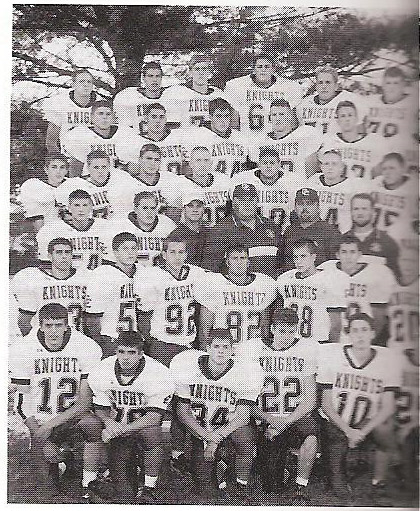
-
I was looking through the names in your old team rosters and looking at how many of those "later generation" namesakes I coached too. Coached three Anthrops and at least ten Schraders. Used to have a saying in the youth program that you couldn't swing a dead cat without hitting a Schrader. For the first time in a long time there's not a Schrader on the player roster; however, there's one on the coaching staff ... one of the ten that I coached in the youth league.
-
The p/p hegemony continues unabated
foxbat replied to Muda69's topic in The Indiana High School Football Forum
Hammond Noll's last winning season was 2006.